

Description
AI Search Optimizer helps your WordPress content get cited by AI search engines.
Traditional SEO optimizes for ranking in search results. AI Search Optimizer focuses on a different goal: getting your content referenced inside AI-generated answers from ChatGPT, Claude, Perplexity, and other AI engines.
What’s included
Cite Score — a transparent 100-point score showing how likely your content is to be cited by AI engines. Calculated across 17 signals in three categories: Structure, Citability, and Authority. The full scoring rubric is published — no black box.
AI Crawler Tracking — see which AI bots visit your site, when, and what they request. Filter by bot, export to CSV, and identify which content AI is paying attention to.
llms.txt Generation — automatically generate llms.txt and llms-full.txt files using your most important content. Integrates with Yoast SEO, Rank Math, SEOPress, and AIOSEO to respect your existing settings.
Gutenberg Sidebar — see your Cite Score and signal-by-signal breakdown directly in the WordPress editor while you write. No context switching.
Post List Column — sortable Cite Score column in All Posts and All Pages. Spot weak content at a glance.
Dashboard Widget — average Cite Score across your site, top crawled pages, AI bot trends.
Why this matters
AI engines now influence a meaningful share of search behavior. Your content can rank well on Google and still be invisible to AI assistants. AI Search Optimizer measures and improves your content’s likelihood of being cited.
About the Cite Score
The Cite Score is the heart of this plugin. Unlike competitors with proprietary “AI scoring” formulas, our rubric is fully public. The 17 signals are documented at https://citewp.com/cite-score, with research citations for every weight.
Built for the future
This plugin is built and maintained by CiteWP. Visit citewp.com for documentation, blog posts on AI search optimization, and product updates.
Screenshots
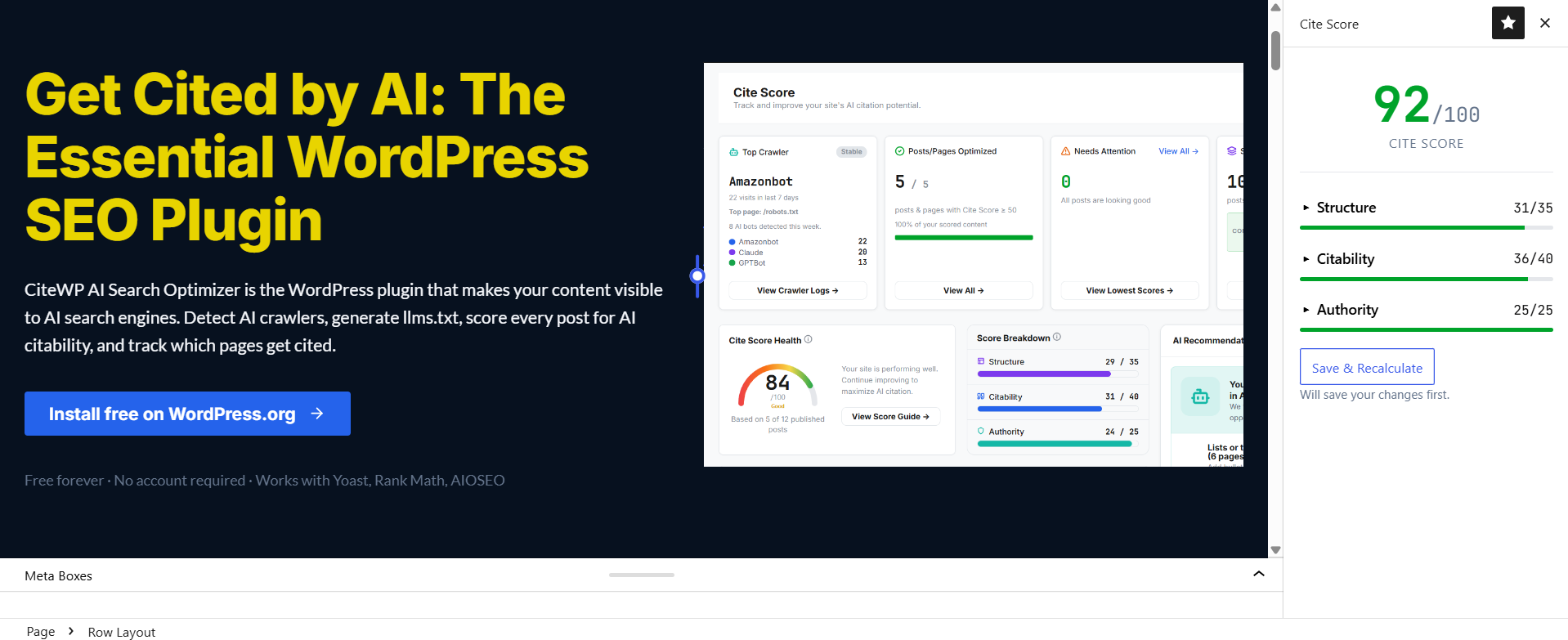
Cite Score in the WordPress editor — a transparent 100-point AI citation readiness score with category breakdown (Structure, Citability, Authority) and signal-by-signal recommendations, shown live in the editor sidebar. 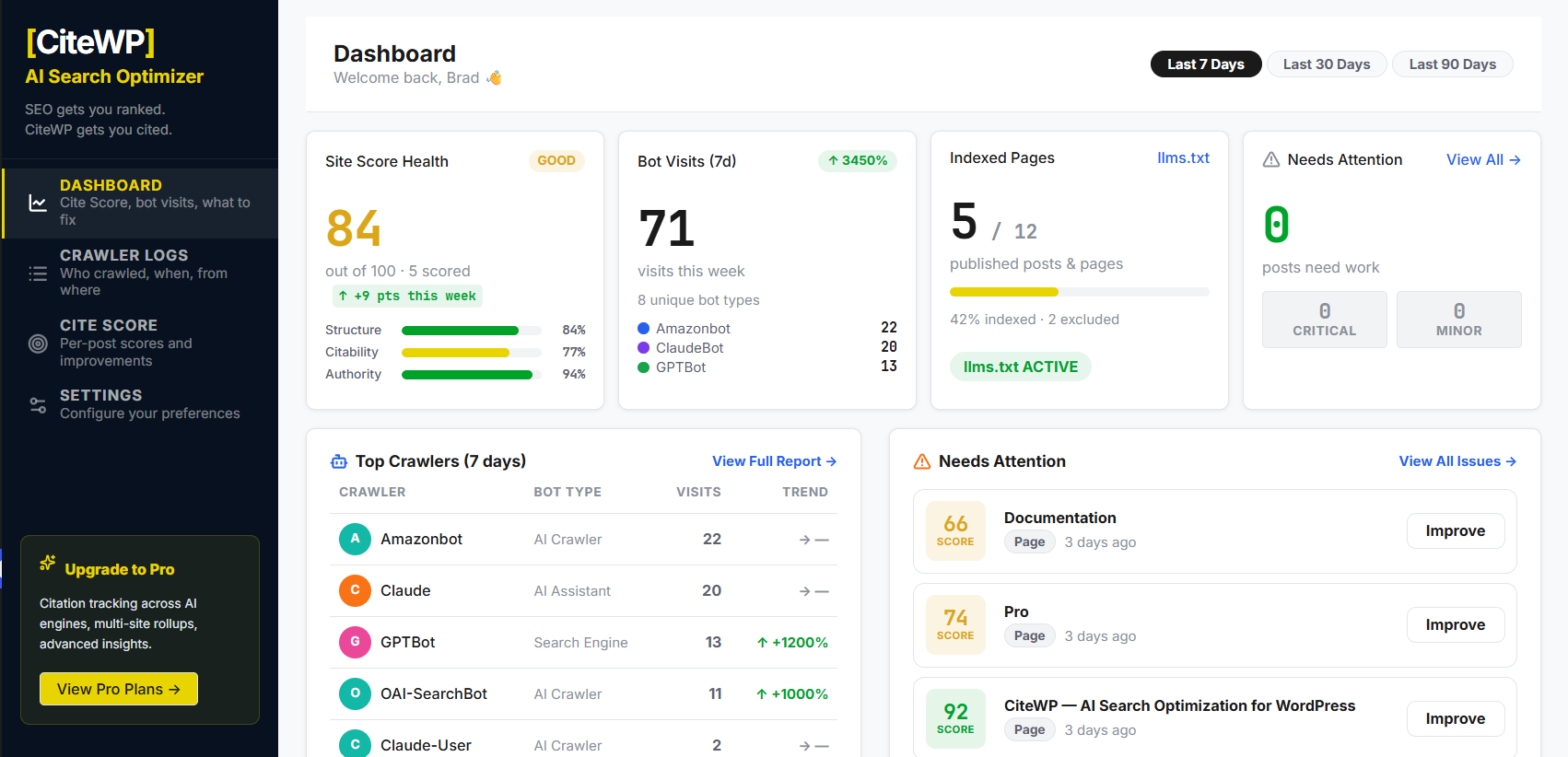
The CiteWP Dashboard — site-wide Cite Score health, AI bot visit totals, indexed-page coverage, top AI crawlers, and posts needing attention, all at a glance. 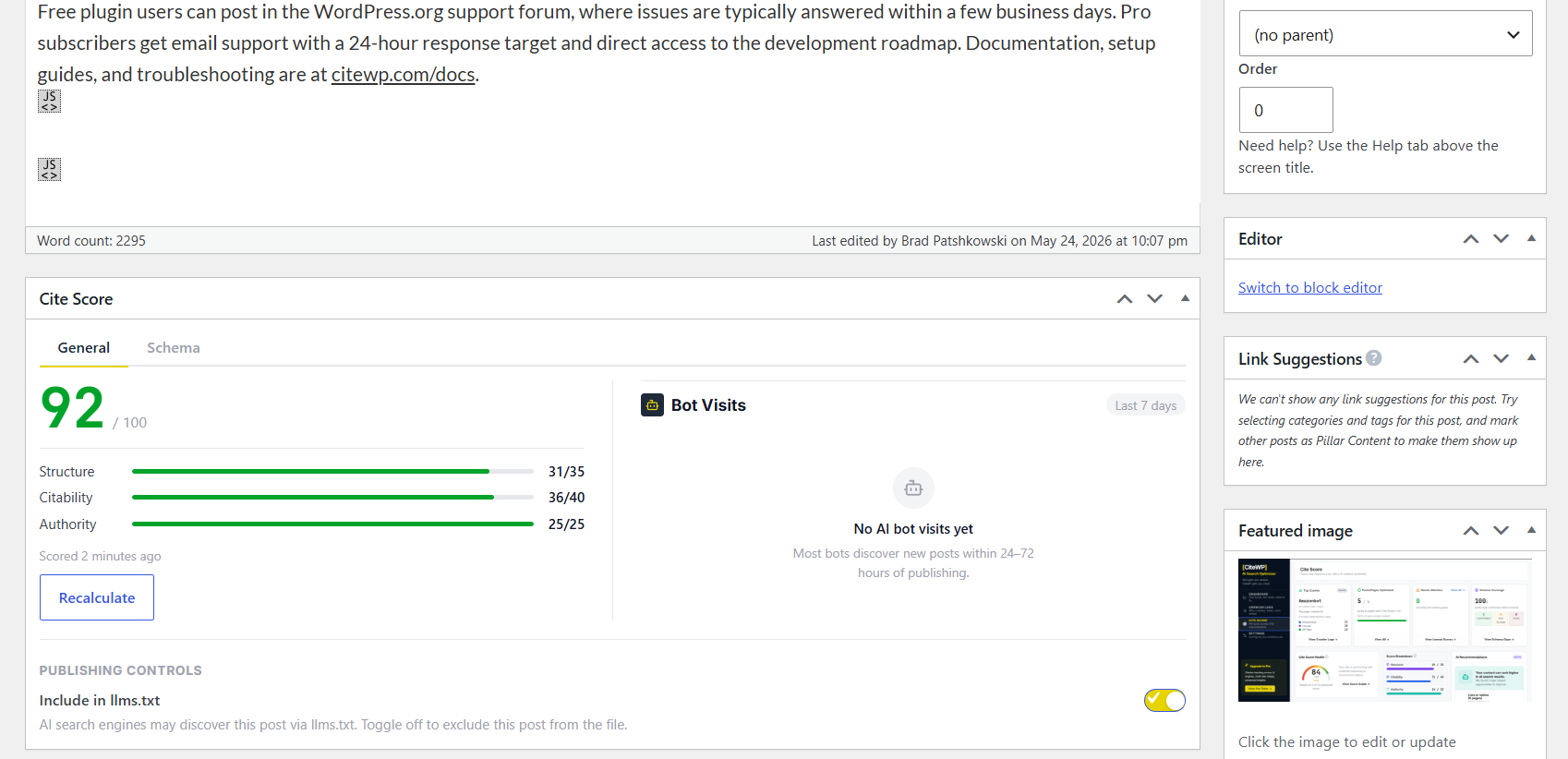
Cite Score in every editor — the universal meta box brings the per-post Cite Score, category breakdown, AI bot visits, and llms.txt controls to the Classic Editor and page builders, not just Gutenberg. 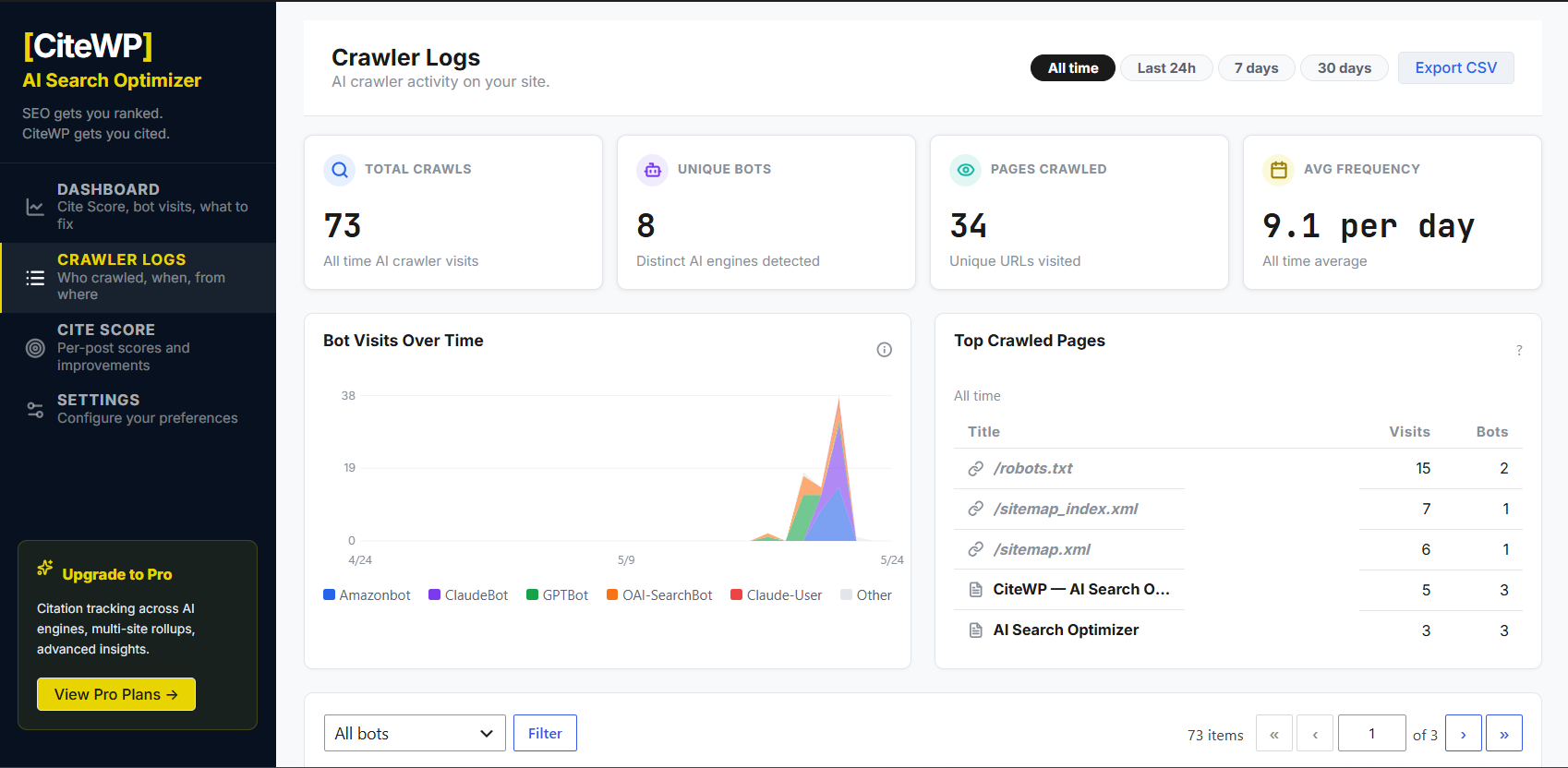
Crawler Logs — AI crawler activity across your site with total crawls, unique bots, pages crawled, a Bot Visits Over Time chart, top crawled pages, bot-type and date-range filters, and CSV export. 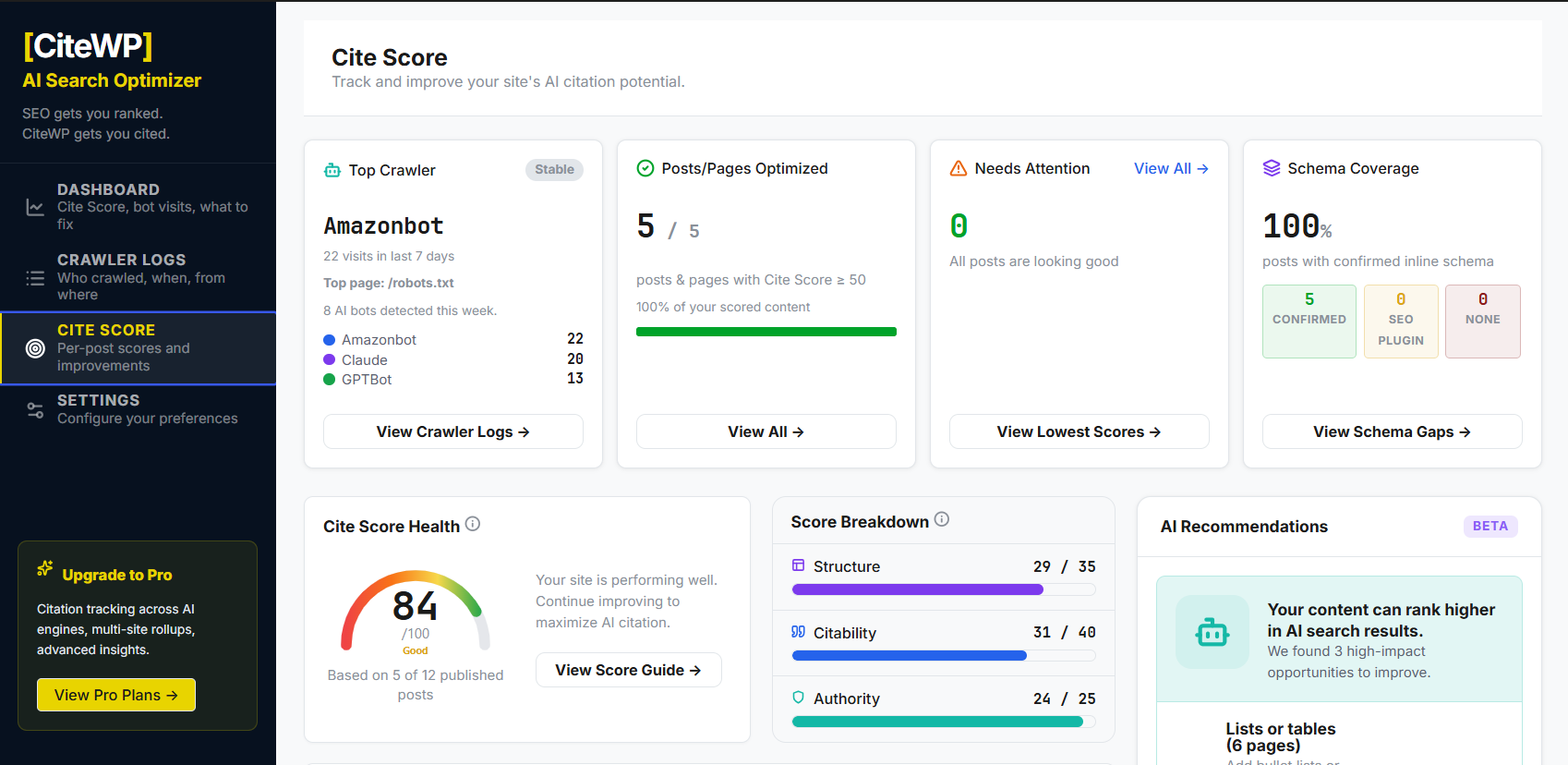
The Cite Score page — site-wide scoring overview with top crawler, optimization coverage, schema coverage, a score health gauge, category breakdown, and AI-powered recommendations.
Installation
- Upload the plugin to /wp-content/plugins/, or install via Plugins Add New.
- Activate.
- AI crawler tracking and llms.txt generation start automatically.
- Open any post or page to see the Cite Score in the editor sidebar.
FAQ
-
Does this replace my SEO plugin?
-
No. AI Search Optimizer complements Yoast SEO, Rank Math, SEOPress, and AIOSEO. Keep your SEO plugin for traditional search; add this for AI search.
-
Is the Cite Score formula public?
-
Yes. The full 100-point rubric is published at https://citewp.com/cite-score with research citations for every signal. Unlike competitor “AI scores,” there’s no black box.
-
Does this work with WooCommerce?
-
Cite Score and llms.txt generation work with any post type, including WooCommerce products. Crawler tracking is site-wide.
-
What’s an llms.txt file?
-
It’s an emerging standard that helps AI engines understand your site’s most important content. AI Search Optimizer generates it automatically, similar to how SEO plugins generate sitemap.xml.
Reviews
There are no reviews for this plugin.
Contributors & Developers
“CiteWP AI Search Optimizer – Optimize Content for AI Engines” is open source software. The following people have contributed to this plugin.
Contributors
Translate “CiteWP AI Search Optimizer – Optimize Content for AI Engines” into your language.
Interested in development?
Browse the code, check out the SVN repository, or subscribe to the development log by RSS.
Changelog
0.7.9
- Schema detection now reads rendered page output, crediting FAQPage and Article schema from any emitter (Rank Math, Yoast, AIOSEO, hand-rolled JSON-LD) equally.
- Schema generation moved from post content insertion to head injection (wp_head), eliminating wpautop corruption and improving compatibility with caching plugins.
- FAQ and Article signals now score independently — Article signal credits validated Article schema only, not generic SEO-plugin presence.
- FAQ extractor fixes: CSS leak in text extraction, br-tag word-fusion, and whitespace handling.
- Tolerant JSON-LD parsing handles hand-crafted schema with embedded line breaks.
- Unicode handling fix — em-dashes and other escaped Unicode characters now render correctly in injected schema.
- Removed block-label as a schema-generation trigger to prevent overwriting existing user-authored schema.
- New REST endpoint POST /citewp/aiso/v1/schema/[id]/inject for Insert/Remove with conflict guard.
- AI Recommendations card on the Cite Score page now excludes llms.txt-opted-out posts from per-signal counts and card visibility, matching the rest of the dashboard’s exclusion behavior.
0.7.8
- Schema detection — emitter-agnostic rendered-output detection via template_redirect full-page cache and sync self-request on Recalculate. Credits schema from Rank Math, Yoast, AIOSEO, and hand-rolled wp:html blocks equally.
- FAQ/Article signal independence — Article/Schema signal gates on Article-type validation, not presence of any schema type; FAQPage-only detections credit the FAQ signal only. Schema detection cache survives content edits and clears on post status transitions only (not every save).
- json_decode_tolerant — hand-crafted JSON-LD with literal CR/LF in string values (accepted by Google Rich Results, rejected by PHP’s strict parser) now parsed correctly.
- Flag-don’t-inject — CiteWP no longer offers to insert FAQPage schema when a valid FAQPage already exists on the rendered page, preventing Rich Result clobbering. Removes the Kadence block-label auto-generation trigger that caused duplicate FAQPage schema insertion.
- FAQ extraction fix — inline CSS from Kadence accordion blocks no longer leaks into acceptedAnswer.text; clean_text() strips style/script noise nodes before extracting text content.
- Head injection — Schema Suggestions Insert/Remove now stores generated schema in post meta and emits via wp_head, replacing block-editor insertion. Eliminates wpautop corruption of JSON-LD in post_content. Insert and Remove buttons backed by REST endpoint with detect-before-inject conflict guard.
- Schema storage — injected schema stored as serialized PHP array instead of JSON string, preventing wp_unslash from corrupting Unicode escapes (e.g. em-dash rendered as ‘u2014’).
- FAQ word-fusion fix — clean_text() replaces br elements with a space text node before reading textContent, preventing adjacent words from fusing at line breaks.
0.7.7
- Cite Score page — ‘Excluded from llms.txt’ pill on per-post table rows for posts excluded from llms.txt generation.
- Cite Score Over Time chart — sparse-data state shown when the selected window has fewer than 3 recorded data points.
- Left rail — ‘Request a Feature’ link below the Pro card.
0.7.6
First public release on WordPress.org.
- Cite Score — transparent 100-point AI citation readiness score across 17 signals in three categories (Structure, Citability, Authority). Full rubric published at https://citewp.com/cite-score with research citations for every weight.
- AI Crawler Tracking — log and filter visits from GPTBot, ClaudeBot, PerplexityBot, and 40+ other AI bots across 19 vendors. Bot-type and date-range filters, summary stats, CSV export.
- llms.txt Generation — automatic llms.txt and llms-full.txt with cornerstone content prioritization. Integrates with Yoast SEO, Rank Math, SEOPress, and AIOSEO.
- Cite Score in every editor — Gutenberg sidebar with per-signal drilldown and on-demand recalculation; universal meta box brings the Cite Score and schema suggestions to Classic Editor, Elementor, Divi, Beaver Builder, and Bricks.
- Schema Suggestions — one-click Article and FAQPage JSON-LD generation with per-post schema type selection. FAQ detection recognizes accordions from Kadence, Elementor, Divi, Beaver Builder, Bricks, Spectra, and HTML5 details/summary.
- Cite Score dashboard — site-wide score, score-over-time trend, per-post score table, AI recommendations, and schema coverage.
- Crawler Logs page — Bot Visits Over Time and Top Crawled Pages, with date-range-aware KPIs.
- Per-post llms.txt control — exclude individual posts or pages from llms.txt; excluded content is also dropped from aggregate score metrics.
- Dashboard widget — average Cite Score, top crawled pages, and AI bot activity at a glance.